
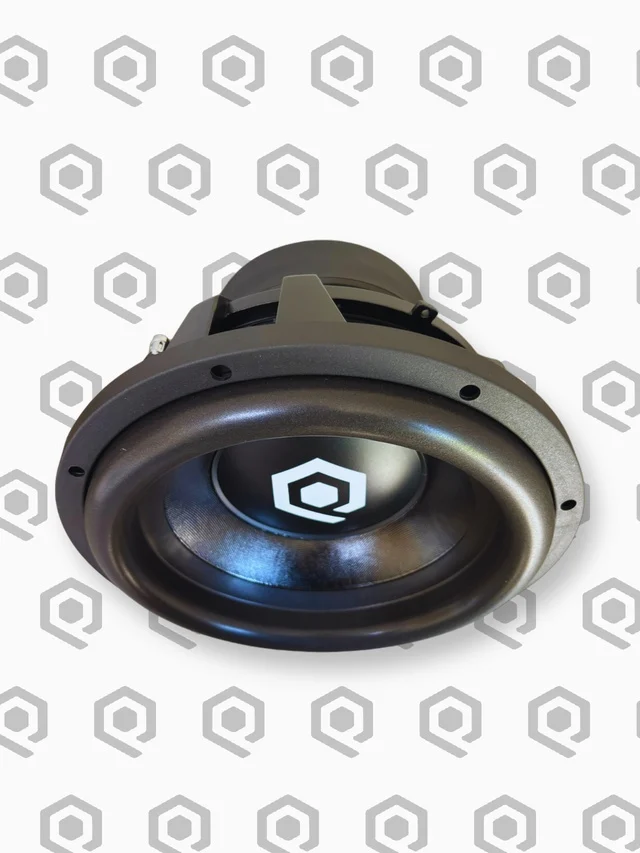
Most of the “my new sub sounds weak” calls we get don’t come down to the sub or the amp. They come down to the box. Put a good 12 in the wrong amount of airspace and it’ll sound thin, boomy or strained no matter how much power you throw at it. Get the volume right and even a modest setup hits clean and low.
This guide covers how much air a subwoofer actually needs, how to measure a box you already own, and the mistakes we see over and over on the install bay.
Why Box Volume Matters So Much
A subwoofer cone is basically a piston riding on a spring. The suspension (spider and surround) is one spring. The air trapped behind the cone is a second spring. Change the amount of air and you change how stiff that second spring is, which changes how the sub moves, where it rolls off, and how much excursion it uses at a given volume.
- Less air means a stiffer air spring. The sub is more controlled and handles power well down low, but the low end rolls off earlier and the response can get peaky.
- More air means a softer air spring. You get deeper extension and more efficiency, but less control. Push it hard and the cone can over-travel.
Every sub is designed around a range of volumes where it behaves best. Your job is to land inside that range, with your actual net volume, not the number written on a sticker.
Typical Airspace by Subwoofer Size
The best number always comes from the manufacturer’s recommendation for that exact driver. If you’re shopping or sketching a build, these are realistic starting ranges for net internal volume per subwoofer:
| Sub Size | Sealed (net ft³) | Ported (net ft³) |
|---|---|---|
| 8″ | 0.3 – 0.6 | 0.5 – 1.0 |
| 10″ | 0.6 – 1.0 | 1.0 – 1.75 |
| 12″ | 1.0 – 1.5 | 1.75 – 3.0 |
| 15″ | 1.75 – 2.5 | 3.0 – 4.5 |
| 18″ | 2.5 – 4.0 | 4.5 – 7.0 |
Treat that table as a ballpark, not gospel. Two 12s can want very different boxes. A high-excursion competition sub with a big motor often wants a different volume than a lighter daily-driver 12, and SPL builds frequently go bigger than the top of these ranges on purpose. When in doubt, look up the driver with our Woofer Lookup and build to the recommendation for that model.
Gross Volume vs Net Volume
This is where most boxes go wrong. Gross volume is the empty space inside the box. Net volume is what the sub actually “sees” once everything else that takes up room is subtracted. Recommendations are almost always given as net.
Step 1: Measure the internal dimensions
Measure the outside of the box, then subtract the wood. With 3/4″ MDF, subtract 1.5″ from each dimension (3/4″ for each wall). If the baffle is doubled up, subtract another 3/4″ from the depth.
Step 2: Do the math
Multiply height × width × depth in inches, then divide by 1,728 to get cubic feet.
Example: a box measuring 30″ wide × 15″ tall × 14″ deep on the outside, built from 3/4″ MDF:
- Internal: 28.5″ × 13.5″ × 12.5″
- 28.5 × 13.5 × 12.5 = 4,809 cubic inches
- 4,809 ÷ 1,728 = about 2.78 ft³ gross
Wedge or angled boxes get split into simpler shapes, or you average the front and back depths if only one face is sloped. Close enough is fine here. You’re aiming for the right range, not three decimal places.
Step 3: Subtract what’s inside
- Sub displacement. The magnet and basket sitting inside the box take up space. A small 10 might displace around 0.05 ft³. A big-motor 15 or 18 can take 0.2 ft³ or more. Check the spec sheet.
- Port volume. In a ported box, the port’s own walls and the air inside the port both count against you. On a slot port with a long run, this can eat half a cubic foot easily.
- Bracing. Window braces and dowels are small individually but add up on larger boxes.
So that 2.78 ft³ gross box, with a 12″ sub displacing roughly 0.15 ft³ and a slot port eating 0.4 ft³, is closer to 2.2 ft³ net. That’s a big difference if you thought you had almost 3.
Sealed Box Volume: What Happens When You Miss
Sealed boxes are forgiving, which is part of why we like them for daily drivers. Still, there’s a limit.
Too small
The air spring gets very stiff. Bass gets tight but thin, the low end falls off earlier, and the sub can sound “honky” or peaky around 50–70 Hz. You end up cranking bass boost to make up for it, which is how voice coils get cooked.
Too big
Low extension improves a little, but control suffers. The sub has less air spring holding it back, so it reaches its excursion limit sooner. In a sealed box that’s way oversized, you can bottom out a sub at power levels it would normally handle without breaking a sweat.
Most sealed recommendations have decent wiggle room. Being 10–15% off in either direction usually isn’t something you’ll hear in a car. Being 40% off is.
Ported Box Volume: Less Room for Error
A ported box is volume and port working together. The port length and area set the tuning frequency, but the tuning also depends on how much air is in the box. Change one and the other moves.
- Box too small for the port: tuning creeps up, the box gets peaky, and you lose the deep stuff a ported box is supposed to give you.
- Box too big: output is usually there, but cone control below tuning gets worse. Add a proper subsonic filter and keep the gain sane.
- Port too small in area: chuffing and port noise at volume, plus compression that robs you of output right when you want it.
If you’re going ported, build to a real design for your driver instead of eyeballing it. We covered tuning in detail in our post on subwoofer port tuning, and it pairs directly with this one.
Multiple Subs: Volume Per Sub
Every sub needs its own recommended airspace. Two 12s that each want 1.25 ft³ sealed need 2.5 ft³ net total, plus displacement for both drivers.
You can put identical subs in a shared chamber. That’s how most dual-sub boxes are built and it works fine, since both cones move together. Don’t mix different models or sizes in one chamber. They’ll load each other unevenly and one will usually end up working harder than the other. If you need different drivers in one box, give each its own sealed-off chamber.
Matching the Box to the Sub and Your Space
Here’s how the airspace question plays out with a few of our subs, using the product specs as listed:
- Tight space, daily driver: The HDS2.3 12″ Dual 2 Ohm (800W RMS) is a solid choice for a sealed box in a sedan trunk or behind a truck seat where you don’t have a lot of room to give up.
- More output, still practical: The HDS3.3 12″ Dual 2 Ohm (1,500W RMS) steps up power handling. It’s worth giving it a properly sized ported box if your trunk allows, because that’s where it really wakes up.
- Serious SPL: The HDX3.2 12″ Dual 2 Ohm (2,500W RMS) is built to be pushed. Builds at that level usually mean big ported boxes, a dedicated wall or a hatch build, and an electrical system to match.
- Small cab or budget build: A pair of HDB2.2 10″ Dual 4 Ohm (400W RMS) subs fits places a single 12 won’t, and two 10s in modest sealed chambers move a surprising amount of air.
Once you’ve picked drivers, run your wiring options through the Ohm Load Calculator so the final impedance matches your amp.
Common Box Volume Mistakes
- Trusting a prefab label. Many off-the-shelf boxes list gross volume, or round up. Measure it yourself.
- Forgetting the port. A long slot port can take a big bite out of a box that looked plenty big on paper.
- Building to the vehicle instead of the sub. It’s tempting to build whatever fills the trunk. A box that’s double the recommended size isn’t “more bass,” it’s less control.
- Leaky seams. A sealed box that isn’t sealed acts like a badly tuned ported box. Glue every joint and seal the terminal cup and the sub’s mounting surface.
- Ignoring cabin gain. A car’s cabin naturally boosts low frequencies. A box that measures a little lean on a test bench can sound full once it’s in a small car, so don’t chase extension you’ll get for free.
Black Friday at SoundQubed
If you’ve been waiting to do the build, right now is 30% off SoundQubed subs, amps and speakers through Nov 30, no code needed. It’s a real discount off our everyday prices, no inflated “was” prices.
Get the Box Right, Then Build Around It
Pick the sub, look up what it wants, measure your space, and do the gross-to-net math before you cut a single panel. That order saves more builds than any amount of EQ after the fact. You can shop subwoofers and amps direct at soundqubed.com, or find a shop near you that builds custom enclosures with our Dealer Locator.
FAQ
How many cubic feet does a 12-inch subwoofer need?
Most 12s land around 1.0–1.5 ft³ net sealed and roughly 1.75–3.0 ft³ net ported. The right number depends on the specific driver, so build to its recommendation.
Is it better to have a box that’s too big or too small?
For sealed boxes, slightly small is usually safer than way too big, since a smaller box keeps more control over the cone. For ported boxes, either mistake shifts the tuning, so it’s worth getting close.
How do I convert liters to cubic feet?
One cubic foot is about 28.3 liters. Divide liters by 28.3 to get cubic feet.
Does polyfill make a sealed box act bigger?
Yes, a little. Loosely filling a sealed box with polyfill can make it behave as if it were somewhat larger. It’s a useful tweak for a box that’s a touch small, not a fix for one that’s way off.
Can two subs share one box?
Yes, if they’re the same model and the box has enough net volume for both. Mismatched subs should get separate chambers.