
Every week somebody asks us the same thing: “My lights dim when the bass hits. Do I need a capacitor or a second battery?” Usually the honest answer is “neither, yet.” Sometimes it’s “the battery, definitely.” Almost never is it “a bigger cap.”
Both parts get sold as the cure for voltage drop, but they do very different jobs. One stores a tiny bit of energy and dumps it fast. The other stores a lot of energy and gives it up slowly. Pick the wrong one and you’ve spent money on a shiny box that doesn’t fix the problem you actually have.
Here’s how we decide in the shop.
First, Understand Where the Power Comes From
With the engine running, your alternator is the power plant. The battery is just a buffer. When your amp asks for more current than the alternator can make, the difference gets pulled from the battery, and voltage starts to sag. Headlights flicker, the amp’s output drops, and if it goes low enough the amp heads into protect.
So before you buy anything, do the math on how much current your system really pulls. A rough formula that works for real-world installs:
Current draw (amps) ≈ amplifier RMS watts ÷ 13.5 volts ÷ efficiency
Class D sub amps typically run somewhere around 75–85% efficient on music, so we use 0.8. That gives you numbers like these:
| Total RMS power | Approx. current draw at full tilt | What it usually needs |
|---|---|---|
| 500W | ~46A | Good ground, correct wire size |
| 1,000W | ~93A | Big 3 upgrade, healthy battery |
| 2,000W | ~185A | Big 3, likely an upgraded alternator |
| 3,500W+ | ~325A+ | High-output alternator plus extra battery storage |
Keep in mind your car’s own loads (fuel pump, fans, lights, HVAC blower) are already eating a chunk of the alternator’s output before the stereo gets anything. A lot of stock alternators land in the 100–160 amp range, and at idle they make far less than their rating.
What a Capacitor Actually Does
A car audio capacitor (a “stiffening cap”) sits close to the amp and holds a small charge. When a kick drum or bass note hits, the cap can release current faster than the electrons can travel all the way from the battery up front. It smooths out very short, sharp dips in voltage.
That’s the whole job. A cap does not:
- Make more power. It only stores what the alternator already put in.
- Add meaningful reserve. Even a big cap holds a tiny fraction of the energy in a battery.
- Fix an undersized alternator. If you’re short on current for seconds at a time, a cap empties almost instantly and you’re right back where you started.
Where a cap helps is a moderate system, maybe 500 to 1,200 watts, on a healthy electrical setup where you notice a little headlight flicker on hard, punchy hits. In that case it can tidy things up. If your voltage is sagging on long bass notes or sustained bass-heavy tracks, a cap won’t save you.
Capacitor install tips if you go that route
- Mount it as close to the amp as you can, ideally within a foot or two of the power input.
- Always pre-charge it through a resistor or test light before connecting. Hooking up a dead cap directly will spark, can weld terminals, and can pop your fuse.
- Keep the main fuse near the battery. The cap doesn’t change your fusing requirements.
What a Second Battery Actually Does
An extra battery adds real storage. When the amp pulls more than the alternator can supply, a second battery near the amp shares the load and holds voltage up for much longer than any cap can. It also gives you playing time with the engine off, which matters if you demo your system or sit at shows.
But a second battery is still storage, not production. If your system pulls 250 amps and your alternator makes 150, the batteries cover the gap for a while and then they’re drained. Run that way for long and you’ll be cooking batteries and wondering why your car won’t start after a meet.
Second battery install basics
- Use the right battery type. AGM is the common choice for inside the cabin because it’s sealed. A flooded battery inside the car needs a proper vented box.
- Fuse both ends. Any power run that connects two batteries needs a fuse within about 18 inches of each battery. A short in the middle is fed from both sides.
- Consider an isolator. A battery isolator or relay keeps your stereo from draining the starting battery when the engine is off. If you play with the car off a lot, this is cheap insurance.
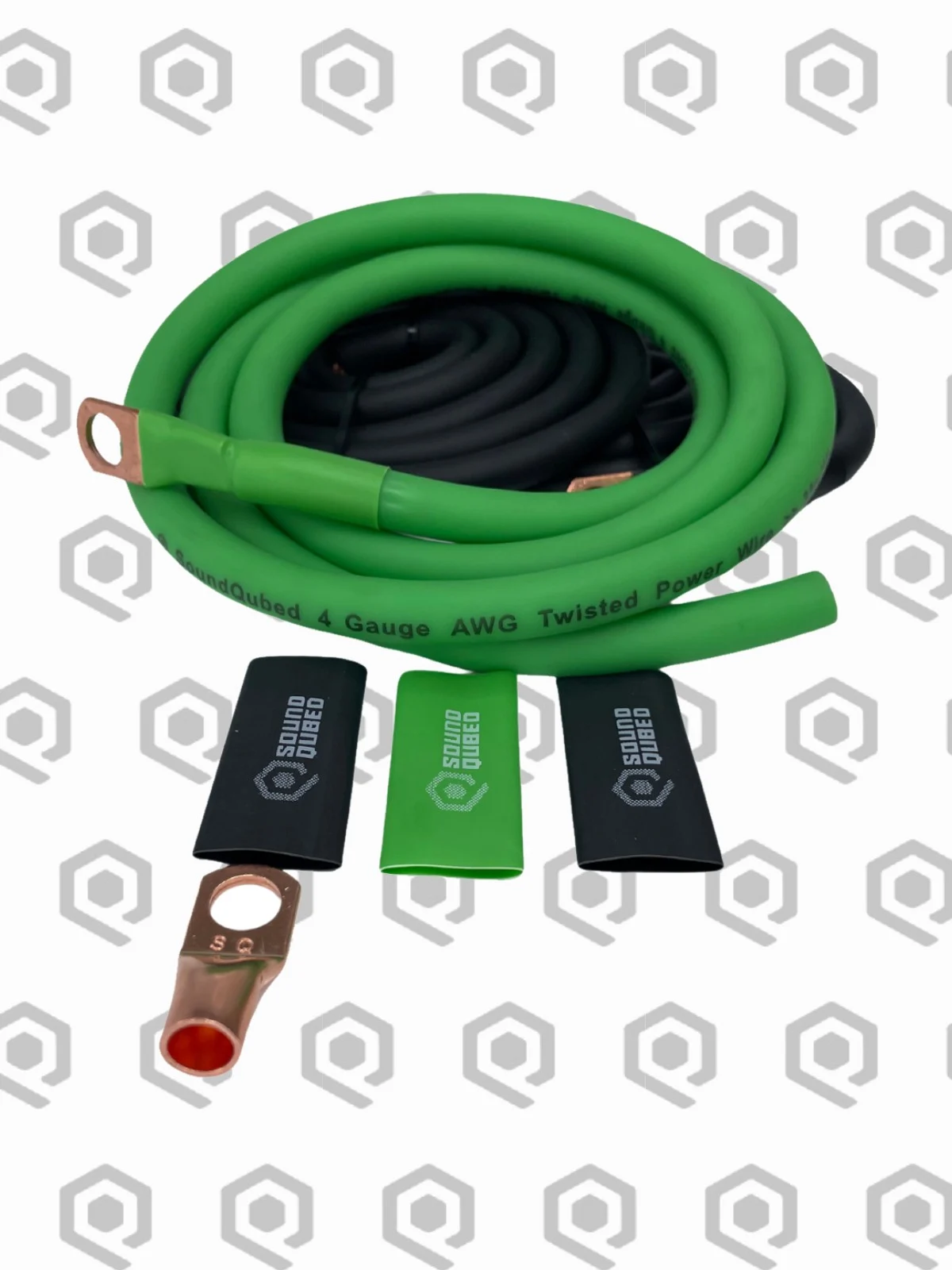
- Match the wire to the load. The run between batteries should be at least as big as your main amp power wire. For bigger systems that’s usually 1/0 gauge power wire.
- Solid grounds. The rear battery needs a short, heavy ground to clean bare metal on the chassis.
The Upgrade Order We Actually Recommend
When a customer rolls in with dimming lights, this is the order we work in. Most people stop at step two or three and are happy.
- Check the basics. Test the battery. Look at your ground: bare metal, short run, tight terminal. Make sure the power wire is the right gauge for your amp. A surprising number of “electrical problems” are a painted ground point or a power wire two sizes too small.
- Do the Big 3. Upgrading the alternator positive, the battery negative to chassis, and the engine block to chassis lets the alternator actually deliver what it makes. A Big 3 upgrade kit is cheap and usually gets you a noticeable bump in voltage under load.
- Set your gains properly. Clipped signal makes the amp work harder and draw more current for no extra clean output.
- Add a cap or a battery based on symptoms. Quick flicker on hard hits in a mid-size system: a cap can help. Voltage sagging on long notes, or you play with the engine off: battery.
- Upgrade the alternator. Once you’re past roughly 1,500–2,000 watts RMS, a high-output alternator is what really fixes voltage drop. Extra batteries then give it a buffer to work with.
Capacitor vs Second Battery: Quick Comparison
| Capacitor | Second battery | |
|---|---|---|
| Stored energy | Very small | Large |
| Helps with | Brief, sharp voltage dips | Sustained draw, engine-off play |
| Fixes a weak alternator? | No | No, only delays the problem |
| Install complexity | Easy (pre-charge required) | Moderate (fusing, mounting, venting, isolator) |
| Best fit | ~500–1,200W on a healthy system | Larger systems, show and demo use |
Real-World Examples
Single 12 on a 1,100-watt amp
Say you’re running an HDS2.3 12″ dual 2 ohm sub (800W RMS) on a C1-1100 monoblock. That’s a very manageable load. Good ground, correct power wire, a healthy battery, and in most vehicles you’re fine. If the lights still blink on big hits, do the Big 3 before anything else. A cap is optional here.
Pair of 12s on a 3,000-watt-plus amp
Two HDS3.3 12s are rated 1,500W RMS each, so you’re pushing serious current. At this level, a cap isn’t going to move the needle. You want the Big 3 done with 1/0 wire, a high-output alternator, and an AGM battery in the back fused at both ends. Run your sub and amp combo through the Ohm Load Calculator so you know the final impedance before you finalize wiring, because the amp’s output (and current draw) changes with the load.
Don’t Skip the Fusing
Whatever you add, fuse it right. The main fuse goes within 18 inches of the battery and is sized to protect the wire, not the amp. A solid set-screw ANL fuse holder with the correct ANL fuse on each battery is the difference between a blown fuse and a burned-out car.
FAQ
How many farads do I need for my amp?
The old “1 farad per 1,000 watts” rule gets repeated a lot, but it’s a rough guideline at best. If your system really needs more than a farad or two to stay stable, the actual problem is usually the alternator or wiring, and more capacitance won’t solve it.
Can a capacitor drain my battery?
Some caps have a digital voltage display or LED that pulls a small amount of current all the time. On a daily driver that’s usually not an issue, but if the car sits for weeks, it can add up. Many caps have a remote turn-on for the display to avoid this.
Do I need an isolator for a second battery?
Not always, but it’s a smart move if you play the system with the engine off. Without one, both batteries drain together and you can end up with a car that won’t start.
Will a second battery stop my headlights from dimming?
It’ll help with sustained draw, but if your amp needs more than your alternator makes, the batteries eventually drain. On bigger systems the long-term fix is the Big 3 plus a higher-output alternator.
Is a capacitor ever better than a battery?
For a modest system with quick, punchy flicker and good wiring, a cap is cheaper and easier to install. For anything bigger, or if you play engine-off, the battery wins.
Get the Power Side Right
Bass only sounds as good as the voltage behind it. Start with grounds and the Big 3, then add storage based on what your system is actually doing. You can grab subs, amps and wiring direct at soundqubed.com, or find a local shop that can test your charging system and do the install right through our Dealer Locator.