
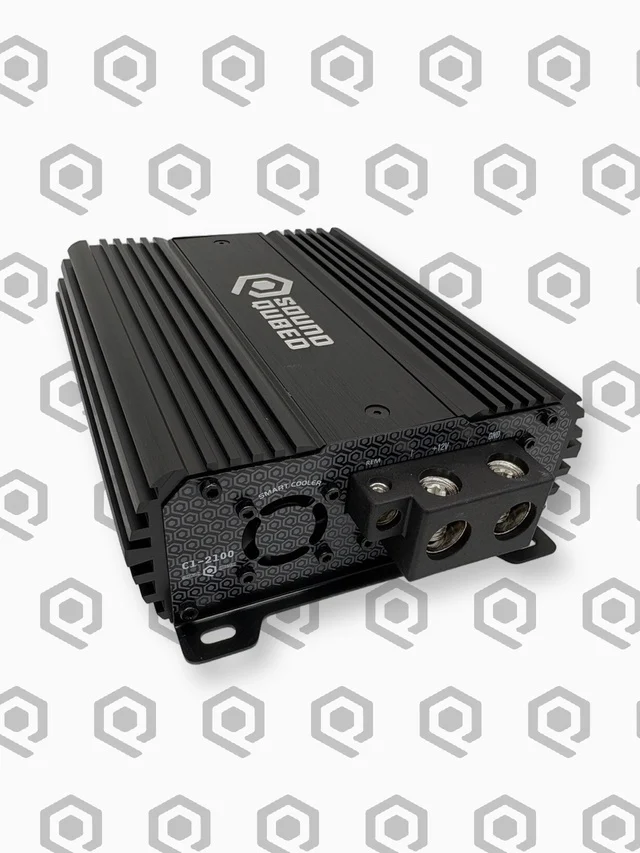
Most people start with one amp on the subs. Then the factory door speakers start sounding thin next to all that bass, and a second amp goes on the wish list. Adding it is not hard, but this is where a lot of installs go sideways. We see it all the time: two power wires fighting for space on the battery terminal, a 4-channel grounded to a seat bolt three feet from the sub amp’s ground, and a buzz through the speakers that nobody can find.
This guide covers how to wire two amplifiers in one vehicle the way an installer would do it: one main power run, a distribution block, the right fuses in the right places, and grounds that don’t create noise.
One Big Run or Two Separate Runs?
You have two ways to feed a second amp:
- Two separate power wires from the battery, each with its own fuse near the battery.
- One larger main wire to the back of the car, split at a distribution block into a feed for each amp.
Both work. For most cars and trucks, the single main run is cleaner. You only pass one wire through the firewall, you only have one big fuse to deal with up front, and the battery terminal doesn’t end up stacked with ring terminals. Two separate runs make sense when the amps are mounted in different parts of the vehicle, like one under a seat and one in the trunk, or when you already have a good run in place and just need a smaller feed for a modest 4-channel.
The rest of this guide assumes the single main run, since that’s what we recommend for the typical sub amp plus 4-channel setup.
Step 1: Add Up What the Amps Will Actually Pull
Everything else depends on this number. Main wire size, main fuse size and alternator concerns all come from total current draw.
A quick way to estimate it: take each amp’s RMS output, divide by its efficiency, then divide by about 13.8 volts. Class D amps run roughly 80% efficient. Class AB amps are closer to 50 to 60%.
Example system: a mono amp making 1,500 watts RMS and a Class D 4-channel making 400 watts RMS total.
- Mono: 1,500 ÷ 0.80 ÷ 13.8 ≈ 136 amps
- 4-channel: 400 ÷ 0.80 ÷ 13.8 ≈ 36 amps
- Total: roughly 172 amps at full tilt
Use RMS, not the big number on the box. And add up the amps’ own fuse ratings as a sanity check. If your estimate is way below the combined onboard fuses, the manufacturer expects more draw than you think.
With a total like that, 1/0 gauge is the right main run for most vehicles. A spool like our 1/0 Gauge CCA Power Wire (50 ft, red) covers the run front to back with enough left for the ground. If you’re not sure where your number lands, our power wire gauge guide goes deeper on run length and CCA vs OFC.
Step 2: Fuse the Main Wire at the Battery
The main fuse protects the wire, not the amps. If that cable ever gets pinched through to the body, the fuse is the only thing keeping it from turning into a heating element under your carpet.
- Mount the fuse holder within about 18 inches of the battery positive terminal.
- Size the fuse to the wire’s capacity and your total draw. It should be at or above what the system pulls, and never above what the wire can safely carry.
- Use a holder that clamps the wire well. A set-screw ANL fuse holder is simple and solid for 1/0 and 4 gauge runs.
Don’t install the fuse yet. Leave it out until every connection is finished and checked. For more on picking the number, see What Size Fuse Do I Need for My Car Amplifier?
Step 3: Mount the Distribution Block
The block goes near the amps, somewhere you can reach it later. Screw it to the amp rack or a solid panel, not floating loose behind a trim piece.
There are two kinds:
- Unfused blocks just split one input into several outputs.
- Fused blocks put a fuse on each output.
Here’s the rule that decides which you need. Any time a wire steps down in size, the smaller wire needs its own fuse sized for it. If your main is 1/0 with a 200 amp fuse and you run 4 gauge to the 4-channel, that 4 gauge is not protected by the 200 amp fuse. It can overheat long before the main fuse blows. So if you step down, use a fused block or add an inline fuse on each smaller lead.
If both amps take the same gauge as the main and the runs are short, an unfused block is acceptable, but most installers still use fused blocks because it costs little and adds protection.
Step 4: Size the Branch Wires
Keep the runs from the block to each amp short. A foot or two is typical. Match each lead to what that amp needs, not to the main.
| Run | Typical gauge | Fuse |
|---|---|---|
| Battery to distribution block | 1/0 for most two-amp systems | Main fuse within 18″ of battery |
| Block to mono sub amp | 1/0 or 4, per amp’s terminal and draw | Block fuse sized to that wire |
| Block to 4-channel | 4 or 8, per amp’s draw | Block fuse sized to that wire |
| Amp grounds | Same gauge as each amp’s power lead | None |
| Battery negative to chassis | Equal to or larger than the main | None |
Check the amp’s power terminal before you buy wire. Some 4-channels won’t accept anything bigger than 4 gauge, and cramming a reduced-strand 1/0 into a 4 gauge terminal is asking for a hot spot.
Step 5: Grounds Are Where the Noise Comes From
Ground mistakes cause most of the alternator whine and buzzing we hear about on two-amp systems. When the amps sit at different ground potentials, current finds a path through the RCA shields, and you hear it in the speakers.
Do it like this:
- Ground both amps to the same point if you can. A ground distribution block bolted to bare metal works well, or stack both ring terminals on one properly prepped chassis bolt.
- If they have to use separate points, keep the ground wires close to the same length and both under about 18 inches.
- Grind to bare metal, use a star washer, and paint over the finished connection to keep rust out.
- Never ground to seat bolts, seat belt bolts or anything with a plastic washer or sealant behind it.
Our full walkthrough is here: How to Ground a Car Amplifier the Right Way.
Step 6: Remote Turn-On and Signal
Both amps need a 12-volt remote signal. You can split the head unit’s remote wire with a jumper at the amp rack. If you’re on a factory radio using a line output converter, it may have a remote output that can feed both. Either way, keep it to one source so both amps turn on and off together.
For signal, the cleanest path is separate RCA pairs from the head unit’s front, rear and sub outputs. If your radio only has one set, some amps offer RCA pass-through outputs, or you can use Y-splitters. On a factory radio, a multi-channel converter like the Q-LOC6 Pro 6-Channel Active Line Output Converter gives you enough channels to feed a 4-channel and a sub amp from one box.
Route the RCAs down the opposite side of the vehicle from the power wire. It’s an old rule because it still works.
A Sample Two-Amp Setup
A common pairing we see: a C1-2100 Monoblock on the subs and a C4-900 4-Channel on the doors. Both are Class D, so they run efficiently and are easy on the charging system, and the wiring follows the steps above exactly: 1/0 main, fused block, a lead to each amp sized to its terminal, and shared ground point.
Before you hook the subs up to the mono, check the final impedance with our ohm load calculator so you know the amp is seeing a load it’s built for.
Check Before You Fire It Up
- Every ring terminal crimped tight and covered with heat shrink.
- Grommet wherever the power wire passes through metal.
- Block fuses in, main fuse still out.
- Amp gains all the way down.
Now install the main fuse, turn the radio on, and confirm both amps power up. Then set gains one amp at a time. Our gain setting guide walks through it.
If the headlights dim hard on bass notes after the second amp goes in, the charging system is the next thing to look at. The Big 3 upgrade is usually the first fix.
Planning the second amp now? Our Black Friday sale is on: 30% off SoundQubed subs, amps and speakers through Nov 30, no code needed. It’s a real discount off our everyday prices, with no inflated “was” prices.
FAQ
Can I run two amps off one power wire?
Yes, as long as the main wire is sized for the combined current draw of both amps and you use a distribution block near the amps. Fuse the main wire at the battery and fuse any smaller branch wires at the block.
Do I need a fused distribution block?
If any wire coming out of the block is smaller than the main, yes. The main fuse is too big to protect the smaller wire. A fused block or an inline fuse on each branch solves that.
Why do I hear whining after adding a second amp?
Usually it’s grounding. The two amps are grounded at different points with different resistance. Move both grounds to the same spot on bare metal and route RCAs away from power wire.
Should the ground wire be the same size as the power wire?
Yes. Each amp’s ground should match the gauge of its power lead, and the battery-to-chassis ground should be at least as large as your main power run.
Do I need a bigger alternator for two amps?
Not always. A moderate sub amp and 4-channel usually run fine on a healthy stock charging system with a Big 3. Bigger systems that dim lights or drop voltage under load are a sign it’s time to look at the alternator.
Get It Done
You can pick up amps, power wire and fuse holders direct at soundqubed.com. If you’d rather have a pro handle the wiring, use our Dealer Locator to find a SoundQubed installer near you.