
Most people who walk into a shop wanting bass don’t want to lose their factory radio. It’s tied into the steering wheel controls, the backup camera, Bluetooth, CarPlay, sometimes the climate controls. Pulling it out is either impossible or a headache nobody wants to pay for. That’s exactly what a line output converter is for.
A line output converter (everybody calls it a LOC) takes the speaker-level signal coming out of your factory stereo and turns it into an RCA signal an aftermarket amplifier can use. It’s a small box, usually a twenty-minute part of the install, and it’s the piece that gets wired wrong more than anything else I see come back into the bay. So let’s go through it properly.
Why You Can’t Just Plug an Amp Into a Factory Radio
Aftermarket head units have RCA preamp outputs. Factory radios almost never do. What they have is speaker wire, carrying an amplified signal meant to drive a door speaker directly.
That speaker-level signal is a lot hotter than what an amp’s RCA input wants to see. Feed it straight into RCA inputs and you’ll get distortion at low volume, or worse, you’ll set your gain in a way that clips the amp and cooks your subs. The LOC drops that signal down to a clean low-level output and gives you a proper RCA connection.
Some amps have built-in high-level inputs, and those work fine for a basic setup. A dedicated LOC still earns its spot when you need more channels, better noise rejection, or an output level control you can actually dial in.
Passive vs. Active Line Output Converters
There are two kinds, and the difference matters more than people think.
Passive LOCs
A passive LOC is basically a pair of transformers or a resistor network. No power or ground wire, just speaker wire in and RCA out. They’re cheap and simple and they work fine on a lot of older vehicles. The downside is they don’t do anything to clean up the signal, and on some newer vehicles they can pick up noise or not play nice with the factory amp’s diagnostics.
Active LOCs
An active LOC needs 12-volt power, ground, and usually provides a remote turn-on output for your amp. Because it has its own power, it can buffer the signal, give you adjustable output levels, and handle the tricky factory systems better. On a modern truck or SUV with a premium factory system, I’d go active nearly every time.
| Passive LOC | Active LOC | |
|---|---|---|
| Needs power and ground | No | Yes |
| Adjustable output level | Limited or none | Usually yes |
| Noise rejection | Basic | Better |
| Best for | Older vehicles, single sub amp | Newer vehicles, premium factory systems, multi-amp builds |
| Install time | Faster | A few more wires |
How Many Channels Do You Need?
This comes down to what you’re adding.
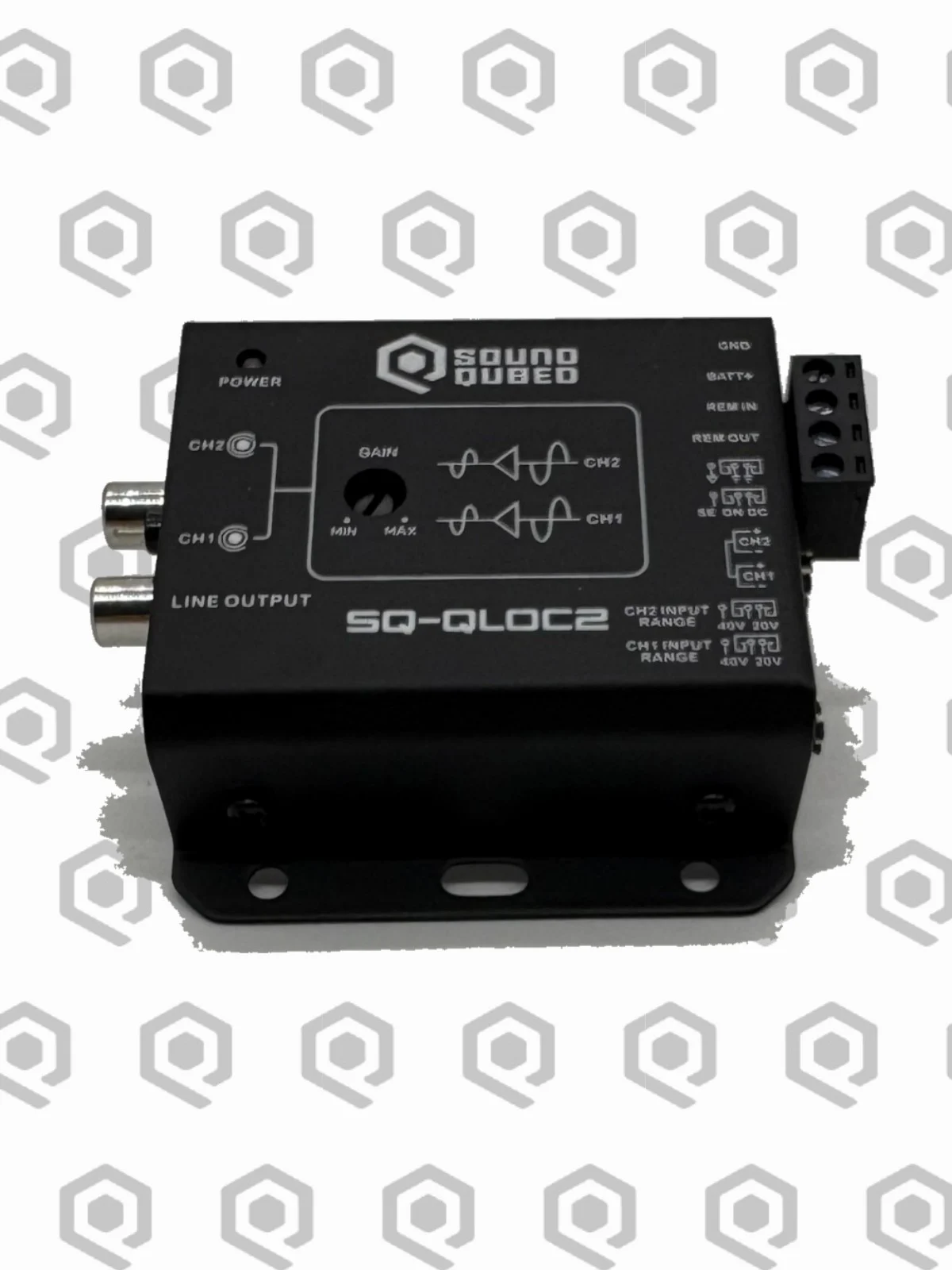
- Just a sub amp: A 2-channel LOC covers it. You tap one pair of speaker outputs, run a left and right RCA to your monoblock, and you’re done. The SoundQubed Q-LOC2 2-Channel Line Output Converter is built for exactly that job.
- Sub amp plus a 4-channel for your doors: You’ll want at least four channels of input so the front and rear speakers keep their own signal, plus something for the sub.
- Full system on a factory head unit: A 6-channel LOC lets you feed front, rear, and sub separately, which keeps fader and balance working and gives you a dedicated bass signal. That’s where the SoundQubed Q-LOC6 Pro 6-Channel Active Line Output Converter makes sense.
If you’re on the fence, buy the bigger one. Adding a 4-channel later is common, and re-tapping the harness twice is the kind of work nobody enjoys.
Where to Tap the Signal
Here’s where installs go sideways. Not every speaker wire in a factory system carries a full-range signal.
A lot of factory systems split the signal before it ever reaches the speakers. The tweeter wires only carry highs. The door woofers might have the low end rolled off. Some systems run a dedicated factory sub channel that’s already been low-passed. If you tap a wire with no bass on it, your new subwoofer setup is going to sound weak no matter how much amp you throw at it.
Rules of thumb I go by:
- Single sub amp, basic system: Tap the rear door speakers. Rear channels usually carry full range and you won’t hear a difference up front.
- Premium factory system with a factory sub: The factory sub output is often a good bass source, but sometimes it’s mono or tuned weird. Test it before you commit.
- Front speakers for a 4-channel: Tap at the woofer, not the tweeter, and confirm you’ve got full range on it.
Use a wiring diagram for your exact vehicle and verify with a multimeter or test tones. Wire colors change between model years more than you’d expect.
Wiring a LOC Step by Step
This is the general order I follow on a sub amp install with a factory radio.
- Disconnect the battery. Every time.
- Find your speaker wires. Behind the radio, at the factory amp, or at a harness under a kick panel or seat. Confirm positive and negative for each channel.
- Make solid connections. Solder and heat shrink, or a quality T-harness if one exists for your vehicle. Avoid the cheap blue tap connectors. They loosen up and you’ll be chasing a cutting-out signal six months from now.
- Mount the LOC close to the tap point and run the RCAs to the amp. Keep RCAs on the opposite side of the vehicle from your power wire if you can.
- Power and ground (active LOC). Pick up a solid ground on bare metal. Use a fused 12-volt source.
- Remote turn-on. If your LOC has signal-sensing turn-on, it’ll trigger the amp when it sees audio. If not, use a switched 12-volt source like an add-a-fuse in an ACC circuit. Don’t tie it to constant power or your amp will sit there idling and drain the battery overnight.
- Reconnect, test, then set levels.
Setting Levels Without Clipping
A LOC adds a second gain stage, so you’ve got two knobs to get right: the LOC output and the amp gain. The goal is to get the strongest clean signal out of the LOC so the amp’s gain doesn’t have to be cranked.
- Set the factory radio to around three-quarters of max volume, with EQ flat and any bass boost off.
- Bring the LOC output up until just before distortion. Some LOCs have a clip indicator; use it if you have one.
- Then set the amp gain. We already wrote a full walkthrough on how to set amp gain without blowing your subs, and it applies here exactly the same way.
Factory systems often reduce bass as volume goes up to protect the little door speakers. Some LOCs have features to deal with that, and some don’t. If your bass seems to fade at higher volume, that’s probably the factory radio, not your sub or amp.
A Simple Factory-Radio Bass Build
Here’s a combination I’d hand a customer who wants clean daily-driver bass and has to keep the stock radio:
- Q-LOC2 2-Channel Line Output Converter tapped off the rear door speakers
- C1-1100 Monoblock Amplifier for the sub
- HDB2 Single 12″ Loaded Ported Subwoofer Box (Dual 2 Ohm, 450W RMS)
That’s a small footprint, it drops right into most SUVs and crew-cab trucks, and it keeps every factory feature working. Before you wire the sub’s voice coils, run your numbers through the Ohm Load Calculator so you know exactly what load the amp is seeing.
Common LOC Problems and Fixes
Whine that changes with engine RPM
That’s almost always a ground issue. Check the LOC and amp grounds, scrape to bare metal, and keep RCAs away from power wire. An active LOC with good isolation helps a lot here.
Amp won’t turn on
Signal-sensing turn-on sometimes won’t trigger at low volume or with some factory amps. Run a dedicated switched 12-volt remote wire and the problem’s gone.
Bass sounds thin
You likely tapped a channel that’s already filtered. Move your tap to a full-range channel and retest.
Factory radio shows a speaker fault or goes silent
Some newer vehicles monitor speaker loads. If the LOC isn’t presenting a load the system expects, it can throw a fault. An active LOC designed for modern vehicles, or leaving the factory speakers connected in parallel with the LOC tap, usually fixes it.
FAQ
Do I need a line output converter if my amp has high-level inputs?
Not always. High-level inputs work fine for a simple sub amp install. A separate LOC is worth it when you need more channels, adjustable levels, better noise handling, or you’re running more than one amp.
Will a LOC keep my steering wheel controls and backup camera working?
Yes. The factory radio stays in place, so everything it controls keeps working. The LOC only listens to the speaker outputs.
Can I tap the front speakers for a sub?
You can, but the rears are usually the better choice. Front channels on some factory systems have the bass rolled off. Just remember that if you tap the rears, fading the radio all the way forward will turn your sub down with it.
Does a line output converter hurt sound quality?
A decent one, wired and leveled correctly, won’t add noticeable distortion. Most quality problems come from bad tap points, poor grounds, or levels set too high.
Should I go active or passive?
If your vehicle is newer or has a premium factory system, go active. For an older vehicle with a basic radio and a single sub amp, a passive LOC can do the job.
Keep the Factory Radio, Add Real Bass
A line output converter is a small part, but it decides whether your system sounds clean or sounds like a mess. Tap a full-range signal, ground it right, set your levels, and the factory radio will drive a real system just fine. You can buy direct at soundqubed.com, or if you’d rather have a pro handle the harness work, find a local installer with our Dealer Locator.