
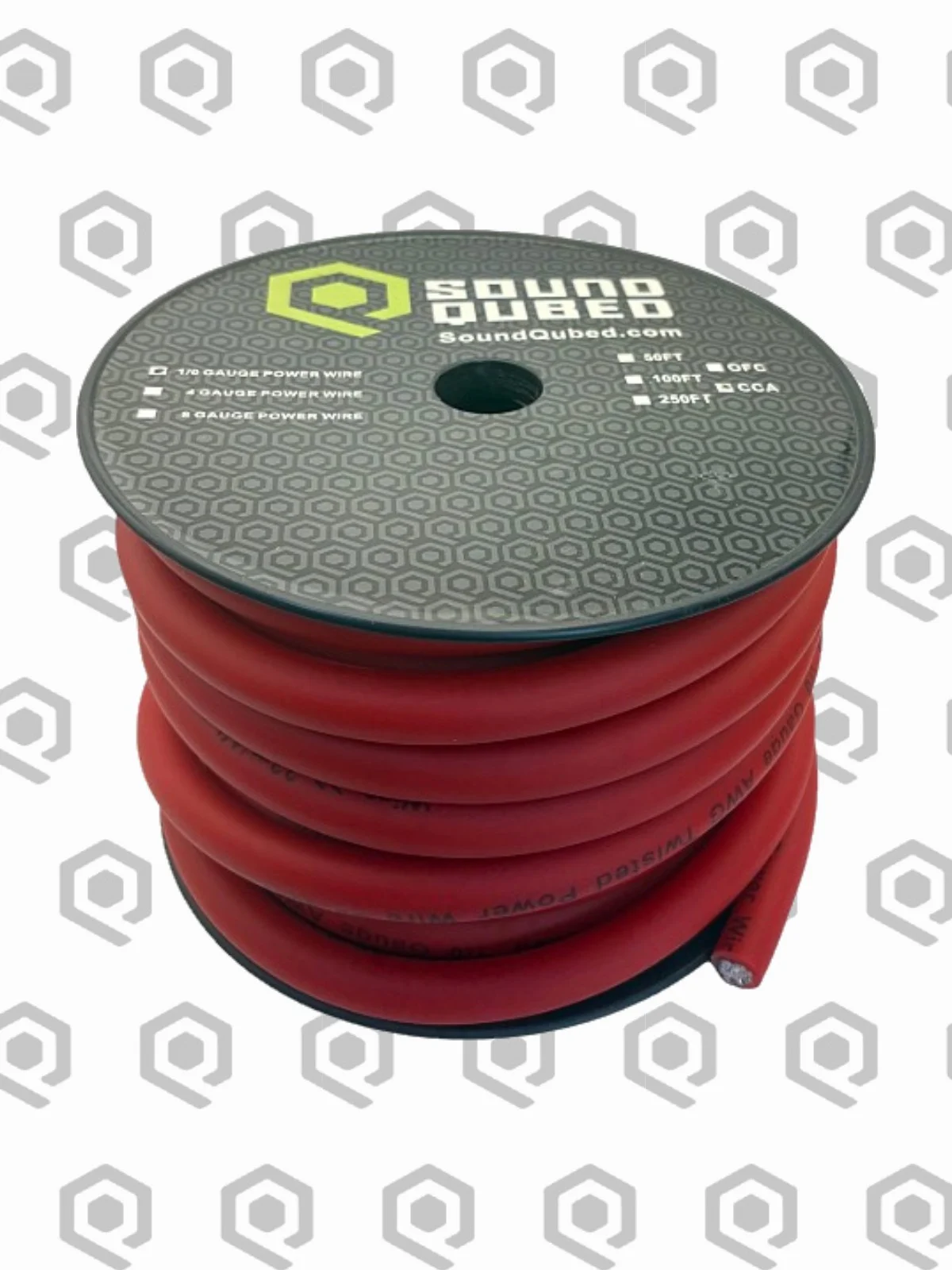
Every week somebody asks us the same thing at the counter: “Is CCA wire junk, or is OFC just a way to charge more?” The answer is neither. Both have a place in a car audio install. What matters is knowing what each one actually does, sizing it correctly, and not getting fooled by a fat jacket with a skinny conductor inside.
Here’s how we think about CCA vs OFC wire after years of running power in everything from daily drivers to wall builds.
What CCA and OFC Actually Mean
OFC stands for oxygen-free copper. It’s solid copper strands all the way through, refined to keep oxygen content very low. For car audio purposes, the big deal isn’t the “oxygen-free” part. It’s that the whole conductor is copper.
CCA stands for copper-clad aluminum. Each strand is an aluminum core with a thin layer of copper bonded to the outside. It looks like copper when you strip it, but most of the metal is aluminum.
That difference drives everything else:
- Aluminum conducts electricity at roughly 60% of copper’s rate, so CCA has more resistance than OFC of the same gauge.
- Aluminum is much lighter and cheaper, so CCA costs a fraction of OFC per foot.
- Aluminum is softer and more brittle when flexed over and over, and it oxidizes faster at exposed ends.
Why Resistance Matters in a 12-Volt System
Your amp doesn’t care what the wire is made of. It cares how much voltage shows up at its terminals. Every bit of resistance in the power and ground path turns current into heat and drops voltage before it reaches the amp.
In a home system running on 120 volts, losing half a volt is nothing. In a car running around 14 volts with the engine on, half a volt is a real chunk. Less voltage means the amp makes less power, runs hotter, and is more likely to hit protection when the bass hits hard.
Here’s a real-world example. Say you’ve got a 1,500-watt RMS Class D amp in the trunk. At full tilt it can pull somewhere around 130 amps. Run 18 feet of power wire from the battery to the back:
- 4 gauge OFC: about 0.6 volts lost on the power run
- 4 gauge CCA: about 0.9 volts lost on the same run
- 1/0 gauge CCA: about 0.4 volts lost
Notice that last one. Bigger CCA beats smaller OFC. That’s the key idea in this whole article.
CCA vs OFC: Approximate Resistance by Gauge
These numbers are ballpark figures for true-spec wire. Actual CCA resistance varies with how much copper is in the cladding and how honest the gauge rating is, but this gets you in the right neighborhood.
| Gauge | OFC (ohms per 100 ft) | CCA (ohms per 100 ft, approx.) | Typical use |
|---|---|---|---|
| 14 AWG | 0.25 | 0.40 | Remote turn-on, door speakers |
| 12 AWG | 0.16 | 0.25 | Speakers, subs on modest power |
| 8 AWG | 0.063 | 0.10 | Small amps, bagger and 4-channel installs |
| 4 AWG | 0.025 | 0.040 | Mid-power subwoofer amps |
| 1/0 AWG | 0.0098 | 0.016 | High-power systems, Big 3 runs |
The rule of thumb we use: if you’re running CCA, go up about two gauge sizes to match what the same OFC gauge would do. Swapping 8 gauge OFC for 4 gauge CCA works. Swapping 4 gauge OFC for 1/0 CCA works. Running 4 gauge CCA where the amp wants 4 gauge OFC is how people end up chasing voltage problems later.
When CCA Makes Sense
We’re not going to pretend CCA is bad wire. Plenty of clean, loud systems run on it. It makes sense when:
- Budget is tight and you’d rather put the money into the amp or subs. A properly upsized CCA run will outperform an undersized OFC run every time.
- The run is long and you’re sizing up anyway. On a big SUV or a crew cab truck, a 20-plus foot run of 1/0 gauge CCA power wire costs a lot less than the copper equivalent and carries current just fine.
- Weight matters. In a race car or a bagger, a few pounds saved is a real thing.
- It’s low-current wire. Remote turn-on leads and modest speaker runs barely notice the difference.
For a mid-power sub setup, a run of 4 gauge CCA power wire paired with a matching ground is a solid, affordable choice as long as the amp’s current draw fits it.
When OFC Is Worth the Money
OFC earns its price in a few situations:
- Space is limited. If you can’t fit a bigger cable through the firewall grommet or under the trim, OFC gets you more current through a smaller wire.
- Terminals have to stay tight for years. Aluminum can creep under set screws and oxidize at the ends. Copper holds a connection better over time, which matters in amp terminals, distribution blocks and fuse holders.
- The wire flexes. Door jambs, motorcycle fairings and hatch hinges flex constantly. Copper handles that better.
- You’re pushing serious power. High-current competition setups need every tenth of a volt, and they usually need it in the smallest cable that’ll fit.
For a 4-channel amp or a compact sub amp, 8 gauge OFC power wire is an easy upgrade that routes cleanly through tight spaces. On the speaker side, 12 gauge OFC speaker wire is a good match for subwoofers and pro audio mids that see real power.
Speaker Wire: Does CCA vs OFC Matter There?
Less than on power wire, but it still matters. Extra resistance in speaker wire adds to the load the amp sees and eats a little power before it reaches the voice coil. On a 1 ohm sub load, even a small amount of wire resistance is a bigger percentage of the total than it would be at 4 ohms.
If you’re running your subs at a low impedance, keep the speaker runs short and use heavier gauge. Not sure what load you’re presenting? Plug your sub configuration into our ohm load calculator before you pick wire.
Watch Out for Fake Gauge
This is the bigger problem in car audio wire, and it hits both CCA and OFC. Some wire is sold as “4 gauge” based on the outside diameter of the jacket, not the copper inside. Strip it and you find a thick layer of insulation around something closer to 8 gauge.
A few ways to spot it:
- The jacket feels unusually thick and squishy compared to the strands.
- The wire is suspiciously light for its size, even for CCA.
- It barely fills a ring terminal or fuse holder rated for that gauge.
- The price seems too good for the length.
Buy wire that’s sold by true conductor size. A properly rated CCA cable is a far better buy than mislabeled “OFC” that’s really two sizes small.
Installer Tips for Either Type
Don’t forget the ground and the Big 3
Your ground wire should match your power wire in gauge and material. A 1/0 power run with a 4 gauge ground is a 4 gauge system. If your lights still dim after sizing the power run correctly, the Big 3 upgrade (alternator positive, battery ground and engine ground) is usually the next fix.
Prep CCA ends properly
Strip it clean, get it into the terminal fast, and snug the set screws firmly. Recheck them after a few weeks since aluminum can settle. Heat shrink over crimped ends keeps moisture out.
Fuse within 18 inches of the battery
Doesn’t matter what the wire is made of. Fuse the power wire close to the battery and size the fuse to protect the wire, not the amp.
Avoid sharp edges
Use a grommet anywhere wire goes through metal. A chafed power cable rubbing on the firewall is one of the few ways a car audio install can genuinely damage a vehicle.
So, Which Should You Buy?
If you have the room and the budget, OFC is the better conductor and holds up better over the years. If you’re watching the budget, CCA sized up two gauges does the job and frees up money for the gear that actually makes the noise. The only wrong answer is undersized wire, whatever it’s made of.
For most daily driver builds we see, CCA power and ground sized correctly with OFC in the tight spots and on the speaker runs is a smart split.
FAQ
Is CCA wire safe for car audio?
Yes, when it’s sized correctly and properly fused. The safety issue comes from undersized wire carrying more current than it should, not from CCA itself. Upsize about two gauges compared to OFC and fuse it near the battery.
Can I mix CCA and OFC in the same system?
Yes. Lots of installs use CCA for long power and ground runs and OFC for speaker wire or short runs in tight spaces. Just make sure each section is sized for the current it carries.
Does OFC wire make my system sound better?
Not directly. Wire doesn’t change tone. It changes how much voltage and power reach the amp and speakers. If OFC lets your amp see more voltage than an undersized CCA run, the system will play louder and cleaner, but correctly sized CCA can get you to the same place.
What gauge CCA wire do I need for a 1,000-watt amp?
It depends on run length and the amp’s actual current draw, but for a typical trunk-mounted 1,000-watt RMS amp, 4 gauge OFC or 1/0 gauge CCA is a safe starting point. Shorter runs and smaller vehicles have more wiggle room.
Get the Right Wire for Your Build
We carry both CCA and OFC power, ground and speaker wire, plus amp kits and fuse hardware, so you can wire your system right the first time. Shop direct at soundqubed.com, or if you’d rather have a pro handle the install, find a local shop with our Dealer Locator.