
Every week somebody asks us the same thing at a show or over the phone: “Should I just grab a powered sub, or do I need a real amp and box?” It’s a fair question. Both will put bass in your car. They just get there in very different ways, and the right answer depends on your vehicle, your budget, and how loud you actually want to go.
I’ve installed a lot of both. Here’s how I explain it to customers standing at the counter.
What Counts as a Powered Subwoofer?
A powered subwoofer (some people call it an amplified sub box or an active enclosure) is a subwoofer, an enclosure, and an amplifier built into one unit. The amp is matched to the woofer from the factory, so there’s no guessing about ohm loads or whether you bought enough power. You run power, ground, a remote turn-on lead, and a signal input, and you’re done.
A component setup is the traditional route. You pick a subwoofer, put it in a box (either a pre-loaded enclosure or one you build), and power it with a separate monoblock amplifier. More parts, more decisions, and a lot more headroom.
Why People Choose a Powered Sub
The biggest selling point is simplicity. If you’ve never wired an amp before, a powered enclosure takes most of the ways you can mess up off the table.
- Matched from the factory. The amp is already set up for the woofer it drives. You won’t accidentally wire a dual 4 ohm sub down to a load your amp can’t handle.
- Faster install. One unit to mount, one set of power wires to run. On a lot of vehicles that’s an afternoon job.
- Works with factory radios. Most powered enclosures accept speaker-level (high-level) inputs, so you can tap your rear speaker wires instead of adding RCA outputs.
- Saves space. No separate amp rack eating up cargo room or bolted under a seat.
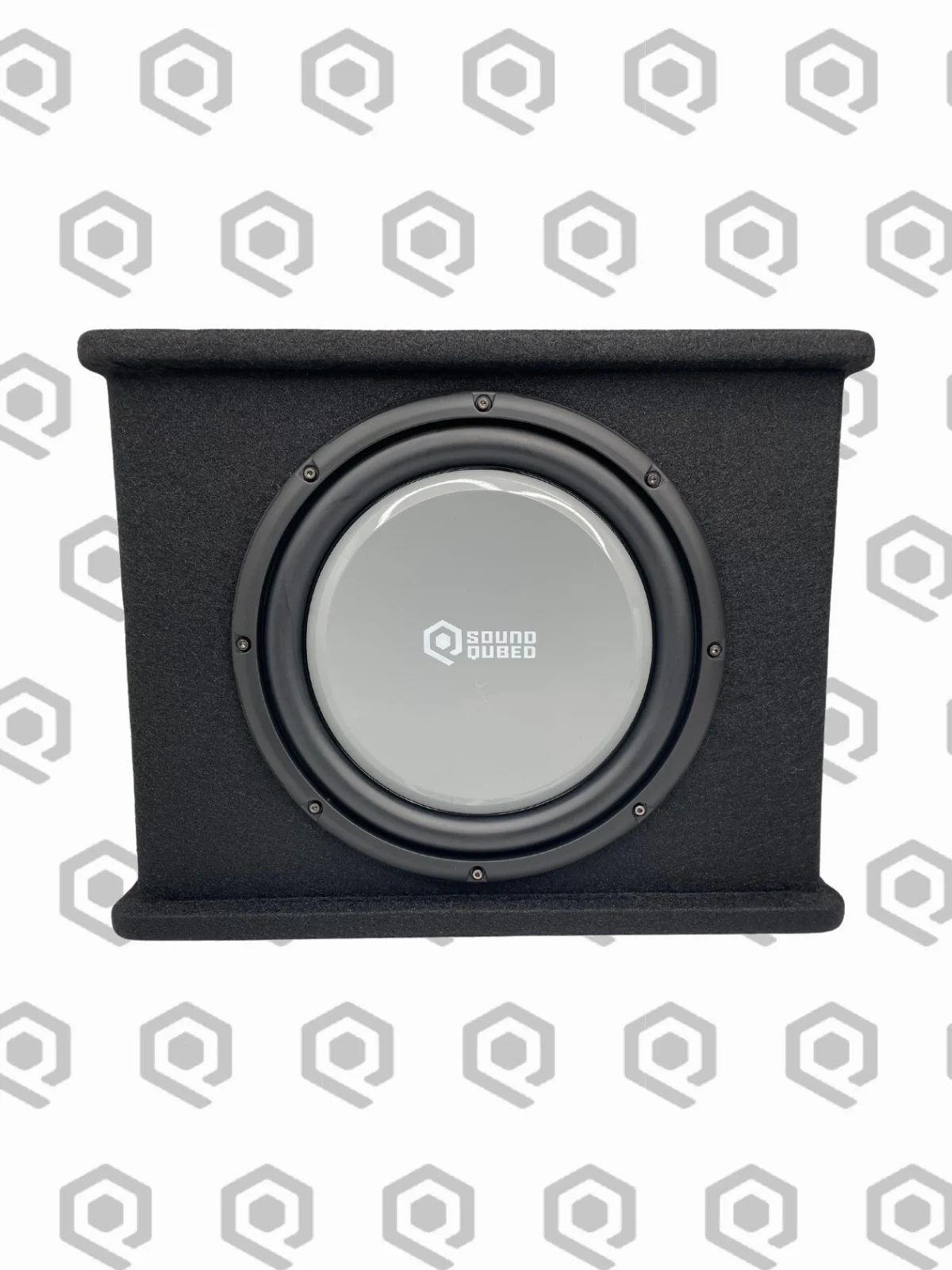
For a daily driver who wants the factory system to stop sounding thin, a powered box is hard to argue with. Our HDS2 12″ Loaded Powered Wedge Subwoofer Enclosure is a good example. The wedge shape sits back against a rear seat or in a hatch without stealing the whole cargo area, and the amp is already inside.
Where Powered Subs Hit Their Limits
Here’s the honest part. A built-in amplifier has to fit inside the box and stay cool in there, so it’s sized for the woofer it ships with. That’s perfect for clean, full daily bass. It’s not what you want if your goal is to rattle the mirrors two lanes over.
A few other trade-offs:
- No upgrade path. If you want more output later, you’re replacing the whole unit instead of adding a second sub or swapping in a bigger amp.
- Fewer tuning options. You get the controls the manufacturer built in. A standalone amp usually gives you more to work with.
- The amp and woofer share a fate. Damage one, and the whole unit is out of service until it’s fixed.
None of that makes powered subs bad. It just means they’re built for a specific job.
Why Separates Still Win on Output
When customers tell me they want to feel it in their chest, or they’re thinking about competing someday, I steer them toward a separate sub and amp. You get to choose exactly how much power goes into exactly which woofer, and you can grow the system one piece at a time.
Take a single 12″ setup. Our HDB2 Single 12″ Loaded Ported Subwoofer Box is rated at 450W RMS with a dual 2 ohm woofer. Wire the coils in parallel for a 1 ohm load, or in series for 4 ohms, and pair it with an amp that delivers roughly that RMS at the load you choose. A monoblock like the C1-1100 gives you plenty of room to work with at that level. Later, if you want more, you add a second box or step up to a bigger woofer without throwing anything away.
Not sure how your coils should be wired? Plug your setup into our Ohm Load Calculator before you touch a single wire. It’ll show you the final impedance for series, parallel, and multi-sub layouts.
The Extra Work That Comes With Separates
Separates ask more of you. You’ll need a power wire sized for the amp’s current draw, a solid ground to bare metal, an inline fuse near the battery, and a way to get signal from your head unit. If you’re keeping a factory radio, that usually means a line output converter. Then you have to set the gain properly. Skip that step and you can cook a perfectly good subwoofer in a weekend.
It’s all very doable. It just takes more time, more parts, and a little more know-how than bolting in a powered box.
Side-by-Side Comparison
| Factor | Powered Subwoofer | Separate Sub + Amp |
|---|---|---|
| Install difficulty | Easy, one unit | Moderate, several components |
| Ohm matching | Done at the factory | Your job |
| Max output | Moderate, limited by built-in amp | As much as your electrical system can support |
| Space used | Compact | Box plus amp mounting space |
| Upgrade path | Replace the whole unit | Add or swap one piece at a time |
| Factory radio friendly | Usually yes, via high-level inputs | Often needs a line output converter |
| Best for | Daily drivers, leased cars, first systems | Big bass, SPL, systems you plan to grow |
How to Decide in About 30 Seconds
Answer these honestly and the choice usually makes itself.
Go powered if:
- You want the factory system to sound full, not window-shaking loud.
- Cargo space matters, or the vehicle is leased and you want an easy removal.
- You’re doing the install yourself for the first time.
- You don’t plan to add more subs later.
Go with separates if:
- You want serious output and you’re willing to upgrade the electrical to support it.
- You like the idea of tuning and tweaking.
- You see this as the first stage of a bigger build.
- You already know what size and model of woofer you want.
There’s a middle ground, too. A pre-loaded enclosure paired with a matched amp gives you most of the output benefits of separates without the hassle of building a box. That’s how a lot of our first-time customers start, and they usually stay happy with it for years.
Don’t Forget the Electrical
This applies to both options. Any amplifier, built-in or standalone, pulls current from your battery and alternator. A modest powered sub on a healthy stock charging system is fine. Once you start running a few thousand watts through a separate monoblock, you’ll want to look at the Big 3 upgrade, and possibly a bigger alternator or extra battery down the road.
The quick tell: if your headlights dim on bass hits, the system is asking for more current than the vehicle can supply. That’s a voltage problem, and it’s worth fixing before it shortens the life of your amp.
Our Take
A powered sub is the smart pick for a clean, simple bass upgrade that you install once and forget. Separates are the pick when you want headroom and room to grow. Neither choice is wrong. The wrong move is buying a powered box when you secretly want an SPL build, or buying a stack of separates when all you wanted was a little more low end on the way to work.
If you’re still on the fence, take a look at the full lineup of subs, boxes, and amps in the SoundQubed shop and see what fits your space and budget.
FAQ
Can I add a powered subwoofer to a factory radio?
In most cases, yes. Powered enclosures typically accept speaker-level inputs, so you can tap into your existing speaker wires without replacing the head unit or adding RCA outputs.
Is a powered subwoofer as loud as a separate sub and amp?
Usually not. The built-in amp is sized for clean daily output. If loudness is your main goal, a separate monoblock driving a properly matched woofer will get you further.
Do I need a capacitor or extra battery for a powered sub?
Not normally. A powered sub on a healthy charging system should run fine with correctly sized power and ground wire. Extra batteries and alternator upgrades come into play with high-power separate amps.
What size power wire do I need?
It depends on the amplifier’s current draw and the length of the run. Follow the amp manufacturer’s recommendation and size up if you’re unsure. Undersized wire is one of the most common causes of weak bass.
Can I upgrade a powered sub later?
Not really in a meaningful way, since the amp and woofer are built together. If you think you’ll want more bass down the road, starting with separates saves you from buying twice.
Get Your Bass Sorted
Whichever way you go, you can buy direct at soundqubed.com and get the gear shipped to your door. Prefer a pro to handle the install? Use our Dealer Locator to find an authorized SoundQubed installer near you.